When Jazz Meets Joy: A Stafford Baptist Story

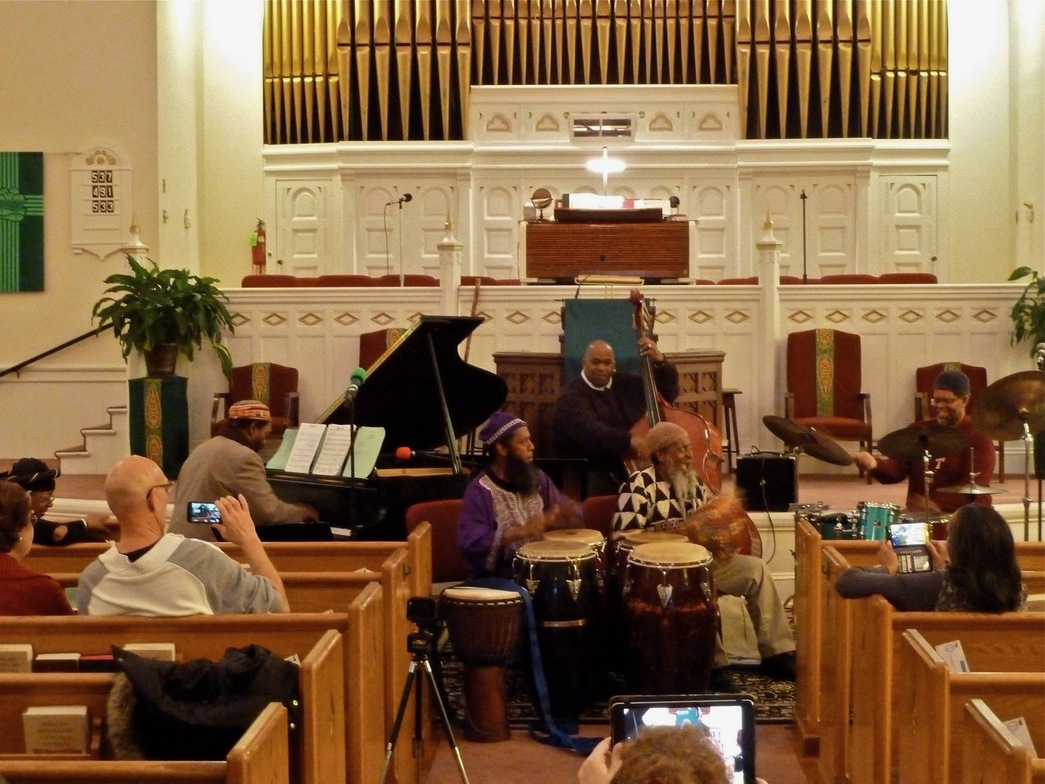
Sometimes ministry begins with a carefully developed plan. And sometimes it begins with a piano that won't stay in tune.
At Stafford Baptist Church, the story of Jazz in the Afternoon began in 2016, when the congregation welcomed an accomplished jazz pianist named Emery Austin Smith as its Minister of Music. Smith, who had performed with jazz legends Count Basie and Dizzy Gillespie, brought extraordinary musical talent to the small Connecticut church.
There was just one problem: the church's baby grand piano couldn't stay in tune for more than two days.
The upright piano in the fellowship hall, dating back to 1909, was actually in better condition. But neither was quite the instrument the church envisioned for its new musician.
So, in February 2016, a trip to Caruso Pianos in New London led to the discovery of a six-foot Yamaha grand piano. With the help of a church member who loaned the purchase price, the piano found its new home in Stafford.
Smith wanted to help repay the loan, and he had an idea: jazz concerts.
And just like that, Jazz in the Afternoon was born.
More Than a Concert
The first concert took place in May 2016, and the congregation quickly discovered that it had created something special.
The concerts were free, ensuring that anyone who wanted to enjoy the music could attend. And because Stafford Baptist was, in Pastor Paula Waters-Scott's words, a church that loved "hanging out with people," each performance was followed by a meal.
The idea was simple: good music, good food, and a welcoming place to gather.
Smith was so enthusiastic that he often wanted to schedule the next concert before sitting down to eat after the previous one. Soon, the church had established a rhythm of concerts throughout the year, including a July celebration of Smith's birthday.
But while the concerts began as a way to pay for a piano, the congregation had another purpose in mind.
The church wanted to reach beyond its walls, welcoming neighbors and visitors and giving them an opportunity to experience God's love.
And people came.
Jazz enthusiasts traveled considerable distances to hear Smith perform. One drummer, Brad Ryan, whom Smith had trained, drove all the way from Bar Harbor, Maine, to play for an hour and a half before heading home again.
Audiences grew into a remarkable mix of generations, cultures, ethnicities, and religious traditions.
Among the concerts' most enthusiastic supporters was a group of Buddhists who regularly encouraged others to attend.
On one occasion, they invited a Chinese doctoral student who had never been inside a church. He arrived feeling nervous, uncertain what to expect. But when he saw people relaxing, laughing, and enjoying themselves, he began to relax, too.
Later, over the shared meal, he had an opportunity to ask the pastor questions about Jesus and Christianity.
It was exactly the kind of encounter the church had hoped to make possible: an open door, a shared experience, and a conversation that might never have happened otherwise.
And Then There Was a Wedding
Of all the unexpected things that have happened at Jazz in the Afternoon, perhaps none can top what occurred on August 23, 2023.
That afternoon, an audience gathered for a special concert featuring the Mike Scott Quartet.
What most of them didn't know was that they were also attending a wedding.
The story began years earlier, when Pastor Paula (then) Waters first encountered drummer Michael Scott in 2013. Their paths crossed again in April 2023, when Scott asked about performing at an upcoming jazz concert.
After receiving Smith's blessing, Scott joined the musicians for the May 20 performance.
Pastor Paula Waters-Scott, who describes helping others discern their calls to ministry as one of her own callings, had also arranged to meet with Scott to discuss his spiritual journey.
But something unexpected was unfolding.
As she watched him play, she sensed that God might have something more in mind for the two of them.
Their first official date was June 1, when Scott accompanied her to her 50th class reunion at MIT.
By August, they were preparing to marry.
Naturally, they decided to do it at a jazz concert.
Only a handful of people knew the plan. The church moderator knew. A few clergy members and out-of-town guests knew. The prayer partner who would officiate knew.
Even Scott's bandmates were in the dark.
Then, after an hour of wonderful jazz, a wedding broke out.
Imagine the audience's surprise!
For Paula, however, the wedding was more than a delightful surprise. It reflected something she had long believed about faith, community, and marriage.
"Marriage is in service to ministry," she explains.
Coming from a family of musicians, artists, social workers, and ministers, she had always understood music and community as expressions of faith. In Scott, a musician and trained clinical social worker from a family of artists, healers, and church planters, she found someone who shared that understanding.
Their marriage became another expression of the ministry that had already been unfolding through the music.
A New Chapter, the Same Spirit
In 2025, when advancing age and health concerns made it impossible for Smith to continue traveling and performing, Michael Scott assumed leadership of Jazz in the Afternoon.
The transition was particularly meaningful because Smith had been a mentor to Scott.
Under Scott's leadership, the musical repertoire has expanded, with musicians encouraged to share their own original compositions.
Scott's group, the Watcherz, also carries a little church history in its name.
When he asked his wife to suggest a name for the band, she thought of the hymn Ye Watchers and Ye Holy Ones, since the musicians were all church musicians.
Scott liked the idea but made one adjustment: he replaced the final "s" with a "z."
The Watcherz were born.
Through changes in musicians and repertoire, the heart of Jazz in the Afternoon has remained the same.
The music is excellent, and the welcome is genuine.
One visitor, surprised by the caliber of the performance, remarked, "I didn't know that we were going to hear professional musicians."
For Stafford Baptist, that combination of musical excellence and generous hospitality has become something of a signature.
God Is Love
On the front of Stafford Baptist Church is a sign bearing three simple words:
God Is Love.
Those words offer perhaps the best explanation of what Jazz in the Afternoon is really about.
The church describes itself as a place where people feel welcome and cared for, a congregation with "no rules" when it comes to extending hospitality.
For nearly a decade, the concerts have brought together people who might otherwise never have crossed paths. They have offered opportunities for gifted musicians to share their talents, for neighbors to become friends, for questions about faith to emerge naturally over a meal, and, on one particularly memorable afternoon, for two people to begin their married life together.
What began as a creative way to pay for a piano has become something much richer.
At Stafford Baptist Church, music opens the door. Hospitality invites people to stay. And love, as the sign out front reminds everyone, is at the heart of it all.